Showing posts with label Noodle. Show all posts

22 June 2013

Tokyo Ramen Street - Ramen Honda

Ramen streets are becoming popular in Japan, as they gather some of Japan's famous ramen shops all within an area so ramen fans do not have to travel far to enjoy a bowl of delicious ramen. 

Tokyo Ramen Street, located at the Yaesu Underground Exit of Tokyo station features some of Tokyo's most famous ramen shops. 


There are a total of 8 ramen restaurants at Tokyo Ramen Street, each with their own special soup and taste. 
Four shops were originally opened in June 2009, namely:
1) Rokurinsha Tokyo (六厘舎TOKYO)
2) Hirugao (塩専門ひるがお)
3) Ramen Mutsumiya (らーめんむつみ屋)
4) Keisuke Kitanosho (蟹専門けいすけ北の章)

The grand opening took place in April 2011, whereby another four shops opened:
5) Shichisai/Tokyo Edoama (麺や七彩/Tokyo江戸甘)
6) Ikaruga (東京駅斑鳩) 
7) Honda (麺処ほん田)
8) Junk Garage (ジャンクガレッジ)

After looking through all the 8 shops, we decided on Ramen Honda as it has a shouyu ramen which L likes, as well as tsukemen which I wanted to try. 

Their menu is simple:

Asari (light) flavour of either shio (salt) or shoyu (soya sauce) ramen which the soup is made using chicken and fish broth. 

Kotteri (rich) flavour tsukemen (dry noodles) of miso or shoyu thick soup which is cooked in Pork and fish broth. 

For the heavy eaters, they also have a variety of rice with toppings side menu to go with your ramen. You can also order almond tofu for dessert (only limited to 20 per day)

As with all the other ramen shops, you have to purchase a ticket at the ticket vending machine outside the shop before entering. 

However, the disadvantage is that most of the vending machines do not have English on it, so it may be a challenge for those who can't read Japanese. 

Pass the ticket to the waitress after you are seated and your orders will be sent to the kitchen. This saves on waiting time to choose from the menu, as well as minimize staff having to handle money. 

L's order of shoyu ramen. Although it looks like a simple bowl of ramen, what is most important is the soup, as well as the noodles. Noodles for the shoyu ramen are made thinner so that customers can enjoy the soup as the noodle will not overpower the soup.

My order of miso tsukemen. As you can see, the noodles and the soup are separated and you have to dip the noodles into the soup.The soup is much thicker than your normal ramen soup noodle and not meant to be drank directly. Noodles are also made thicker so that they can be fully coated with the thick broth. 
I also like that it comes with a lemon as the sourness of the lemon balances out the taste of the thick broth. 

No matter what kind of ramen you like, there will sure be one ramen shop which is of your liking. However, do note that you may have to wait for approximately 30 minutes on average during meal times. 


Tokyo Ramen Street- Ramen Honda

Tokyo station B1F Yaesu South Exit (First Avenue Tokyo station B1F south street) 
Open daily: 11am - 10.30pm (hours may vary by shop)
(Rokurinsha & Shichisai open from 7.30am onwards)

www.tokyoeki-1bangai.co.jp/ramenstreet (Japanese only)


26 May 2012

Menya Musashi, 麺屋武蔵 Raffles City

Singaporeans just can't get enough of Japanese food. With the recent boom of Japanese ramen chains opening in Singapore, Menya Musashi in Raffles City has seen long queues outside their restaurant daily, for the eager Singaporean waiting to try out the latest ramen in town.

Ms K had urged us to go there since I told her about their opening a few months ago. The restaurant is located on the 1st floor of Raffles City Shopping Centre, the first shop when you enter from the entrance along North Bridge Road. 

Menya Musashi is a popular ramen chain in Japan, having 11 stores in Tokyo. And each of the 11 stores sell their own specialty ramen and soup base. 

When we arrived around 630pm on a Friday night, there was already a very long queue forming outside the restaurant. Even so, we still joined the queue, as our main motive was to try out this ramen joint that day.

When you are nearer the front of the queue, the waitress would pass you their menu. Their soup bases are all tonkotsu (pork bone) broth, but there are 3 types for you to choose: White Musashi (the original tonkotsu) Black Musashi (with fried garlic and onion) and Red Musashi (spicy bean paste). 
 
But the signature dish of Menya Musashi is their Tsukemen. "Tsuke" in Japanese means to add, or to attach. "Men" of course means noodles. Hence tsukemen means to dip the noodles into the soup broth. 
Compared to ramen, tsukemen is a popular dish in Summer for Japanese as the weather is too hot to have a piping hot bowl of ramen. 

And here in Menya Musashi, you can actually choose the amount of noodles you want for your tsukemen - all for the same price! I wonder who will order the 5 x regular though... 


After queueing for close to 1 hour, we finally managed to get a table. (they only allow you in when everybody in your group has arrived). The kitchen is an open kitchen concept and you can see the chefs busily preparing the overwhelming ramen orders. 

As usual, we had to order some side orders for sharing, not contented with just a bowl of ramen. 

Ms K's white char siu ramen came first. Soup base looks pretty thick. 

Next came our tsukemen orders. Each of us actually ordered a different kind of soup base. 

I ordered the black tsukemen, with 2 x noodle serving. Hey, an angry man is a hungry man! having queued for 1 hour, I sure am hungry! but 2 servings is really a tad too much to finish. 1.5 servings would have been just nice. 

The other 2 soup bases (white and red) look nice and thick too. In fact, the soup base for the tsukemen is much thicker than that compared to the ramen. Ms V commented that the white soup base just looks like 花生糊 and my black soup base 芝麻糊.

The noodles are the thick straight type of noodles, and these are best suited to be used for tsukemen. 

If you realise, their char siu is individually seared (most probably with a fire gun? ), as I could taste the slight burnt taste of the pork, which adds another fragrance to the char siu. 
However, the char siu seemed to get cold quite fast, and the fats in the middle had coagulated when I ate the last piece. 

Unlike Ippudo's tsukemen, which hot clear soup is provided to you to add into your tsukemen broth after you finish you noodles, Menya Musashi doesn't provide this service. 
Their eggs are also abit overcooked, as the yolks were not runny in the middle and the menya (bamboo shoots) was also quite hard, and not so easy to chew. 

Menya Musashi in Japan has a reputation of serving good ramen, but this branch in Singapore seems not to live up to the reputation. I guess I had too high hopes on it. But being a ramen lover, I'll still give them a chance and maybe return back a few months later for my dosage of tonkotsu tsukemen. 

Menya Musashi, 麺屋武蔵

252 North Bridge Road, 
#01-16 Raffles City Shopping Centre

Nearest MRT: City Hall

Open daily: 1130am - 10pm

14 May 2012

Ramen Mutekiya 麺創房無敵家


Among the fierce battles of ramen joints in Ikebukuro, Ramen Mutekiya (無敵家) is my favourite for the following reasons:
1) thick and creamy tonkotsu broth (tonkotsu broth is my favourite type of broth, among shoyu, miso or shio broth)
2) thick and chewy noodles using 100% Hokkaido flour (I still prefer the thick noodles to the thin noodles like what Ichiran is serving)
3) this might sound extremely sinful to many, but Mutekiya adds fresh pork back fat cooked for 3 hours to make the soup even more flavourful.
4) their tender charsiew, with the right amount of fats to make it juicy.
5) their complimentary spicy takana vegetables (picked mustard leaf) locally grown in Kumamoto, Kyushu. And it's really spicy!
6) another complimentary item - low-odor garlic from Aomori prefecture. And you get the enjoyment of crushing the garlic yourself, with the special garlic crusher.
7) jasmine tea concentrate for you to add into your drinking water, to assist in fat absorption after your heavy meal 


When we arrived at about 11pm, coupled with drizzling rain and cold weather, there was still a long queue waiting outside the restaurant, which is normal for Mutekiya. I would be surprised instead if there was no queue. 


The staff would pass you the menu when you are queuing outside, so that you can decide what you want to eat while waiting. 


Shortly later, he will come and take your order. This ensures that once you get a seat inside the restaurant, the cooks would already be preparing your ramen. After you order your ramen, he will ask you - big portion (oomori) or normal portion (nami mori) of noodles. Prices are the same, so if you are big eater, you can opt for the oomori (230g). Of course we ordered the nami, which is 150g.
However, after you have decided on your noodle portion and have started eating your ramen, additional noodle portions will be chargeable at JPY100. 


Some signages displayed at their doorstep. 
The left one indicates that takeaway ramen is not served (this is so to ensure that customers will have the best bowl of noodles, and not cold or soggy noodles). 
The one on the right indicates that they use 100% Hokkaido flour, and low odor garlic from Aomori prefecture.


We finally reached the first on the queue line. But you still have to wait outside until a seat is available. Although the queue seems quite long, but we waited for approximately just 20minutes.
If you realise, opening hours are from 1030am to 4am, so no problem for a late night ramen supper, which is a must do for Japanese after a night of drinking. 


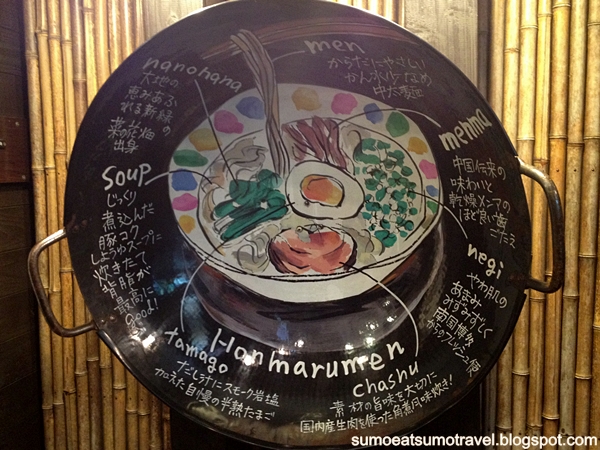
This special pot hung outside the restaurant describes all the ingredients which goes into their "Honmaru men" (本丸麺) which is also the ramen I ordered. 


The shop is only a small space, with a total of 17 counter seats. 


Everybody is busying eating their ramen. No time for chit chats. 


The following condiments are displayed on the table. Soya sauce, vinegar, chilli oil, pepper and tonkotsu shoyu, for customers who prefer a heavier soup base.


These are the 3 complimentary ingredients to add on to your ramen - spicy takana, fresh garlic and bonito powder.  


They are also very considerate towards customers. You can ask the staff for a free paper apron to wear it over your clothes, to prevent the soup from splashing onto your clothes. Perfect for office workers who are always in white shirts. 


First came our gyoza. I don't normally order their gyoza as the main highlight is their ramen. But their gyoza is delicious too! crispy skin with juicy meat.


Finally my long awaited Honmaru ramen (JPY780, approx SGD12). Can you imagine waiting outside in the cold and rainy weather for close to half and hour and finally a bowl of piping hot ramen arrives in front of you. The euphoria of taking the first sip of soup is indescribable! 


The noodles look like our yellow noodles, but they are definitely not. The noodles are cooked just right, and has a springy bite to it. In my opinion, thick noodles goes best with thick tonkotsu soup. 


You can see the bits of pork back fat in the soup. However, it does not make the soup any oily at all. 


The egg is also cooked perfectly well - still flowy in the middle, but the egg white still remains soft. 


Besides their main tonkotsu soup base ramens, Mutekiya also serves tsukemen, and rice bowls. Unlike most ramen shops which only have a few ramen selections, Mutekiya has a variety of close to 15 types of ramen and more than 10 types of toppings. You are sure to find one to your liking!


Mensoubou Mutekiya 麺創房無敵家
1-17-1, Minami Ikebukuro, Toshima-ku, Tokyo
東京都豊島区南池袋1-17-1
Open daily: 1030am - 4am
Closest train station: Ikebukuro east exit


26 April 2012

Mak Man Kee Noodle Shop, 麥文記麵家

Our last meal in Hong Kong before we leave for airport - some authentic Hong Kong style Wanton Noodles! Just near our hotel happens to be one recommended by Mr L's Hong Kong relative - Mak Man Kee Noodle Shop ( 麥文記麵家).  Their location just happens to be beside Australian Dairy Co. as well. 


You won't miss out their big signage. 


The noodle shop is quite small, with seating capacity of about 30 seats. Tables are also very small, and as usual you will have to share tables. Popular dishes are the wanton noodles, as well as the pork knuckle noodles which I see many people eating. Tempted to order this, I still settled for the wanton noodles in the end. 


It's actually a very small bowl of noodles. Where's the wanton? you may ask...


The "treasure" is at the bottom.. you will have to dig into the noodles to find the wanton. There are actually 4 wantons in a bowl of noodles. 


This is really comfort food... after a tiring day of shopping in the cold, being able to sit down to have a bowl of piping hot wanton noodles, not too big a portion, together with crunchy prawn wanton ends our Hong Kong trip in great fulfillment. Till then again... bye bye Hong Kong! I'll be back soon!


Mak Man Kee Noodle Shop, 麥文記麵家


G/F 51 Parkes Street, Jordan
佐敦白加士街51號地下
Open daily: 12 noon - 1230am 
Nearest MTR station: Jordan, exit C2

Related Posts Plugin for WordPress, Blogger...