Showing posts with label Niigata. Show all posts

4 March 2013

Niigata Furumachi 古町

The best way to move around Niigata city is by their sightseeing bus, which stops at popular tourist spots in downtown Niigata. A 1 day pass cost JPY500 with unlimited rides on the bus. 


Furumachi (古町) meaning 'old town' in Japanese is a shopping street lined with shops and stalls at both sides of the streets. 

You can find a variety of stores selling various types of local produce along Furumachi.

The store sells various pickled vegetables or what we call "Tsukemono" in Japanese. 

The fresh vegetables are very cheap! A big bunch of Niigata leek only sells for JPY120 (SGD2) !! And the daikon at JPY150 ? It's such a big daikon!

This store sells dried vegetables. Do you know what is the dried stuff beside the dried chilli ? We took a long time to figure it out too! It's actually dried daikon. They call it Kiriboshi Daikon, literally meaning cut dried daikon. It is normally blanched in boiling water can be used in a variety of dishes. 


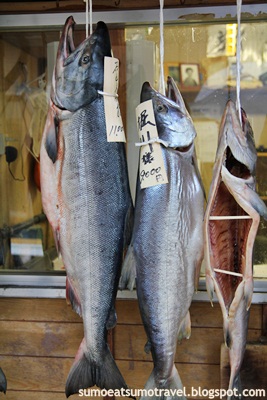
Dried salmon is also a popular item in Niigata. Whole salmon is preserved in salt and hung up to dry during winter. 


Some dried salmon specialty stores have the customer's name and price of the salmon attached to the fish. A average sized dried salmon sells for approximately JPY7000 (SGD100).  

Another local specialty of Niigata is the Sasadango. Sasa - meaning bamboo leaves in Japanese and dango meaning mochi balls. Sasadango - a glutinous rice flavoured with mugwort, filled with red bean paste wrapped in bamboo leaves. 


Besides red bean filling, there are also other fillings, such as salty filling - Japanese kelp, kinpira or the gold award winning white bean filling sasadango. 


A copy of the sightseeing bus route can be downloaded here


24 February 2013

Niigata Tonkatsu Taro とんかつ太郎

We came across this shop in the local brochure of the list of recommended foods in Niigata city. 

Tare Katsu don is a local specialty in Niigata, meaning the pieces of Tonkatsu are dipped in a special sauce before serving it on top of piping hot rice. 

Wanting to find some simple and easy to eat food, we decided on this restaurant, as it was also centrally located at the Furumachi street. 

A simple 2 storey restaurant, with counter seats on the 1st storey and tatami table seats on the 2nd. 

The menu is a simple selection of either teishouku (set with separate rice and miso soup) or don (ingredients are put on top of the rice). 

I ordered the katsu don (JPY970). 5 pieces of tonkatsu over the rice! The meat is not too fatty, but still preserving the juices. And the tare (sauce) makes the meat more flavourful. 

For the big eaters, you can order the tokusei (特製) katsu don with 7 pieces of tonkatsu at JPY1250, or a mini katsu don with 3 pieces of tonkatsu is also available at JPY750. 

L ordered the chicken katsu teishoku (JPY1000) and the chicken was also fried just perfect. Still juicy in the inside while crispy on the outside. 

It's no wonder why Tonkatsu Taro is recommended in the Niigata restaurants brochure. Simple and good value for money food is the best!


Tonkatsu Taro (とんかつ太郎)

新潟市中央区古町6番町973
6-973 Furumachi dori, Niigata shi
Opening hours : 1130 - 1500 hrs / 1700 - 2030hrs (Sat,Sun & PH ~2000hrs)
Closed every Thursday and 3rd Wednesday of the month

Niigata Pia Bandai

One of the major industry in Niigata Prefecture is agriculture. Niigata ranks 2nd after Hokkaido in rice output. 


Niigata is well known in producing a rice variety called "Koshihikari" or what we call 越光米, widely considered to be the highest quality rice produced in Japan. 

We went to a local produce place called Pia Bandai , which sells all types of food, from fresh seafood, to food souvenirs to alcohol. 


 The warehouse here sells koshihikari rice by the weight. Prices are cheap, considering 1kg of koshihikari rice only sells for below JPY500 or SGD7.


This is very common in Japan whereby they will put the farmer's photo and information up, so that you know who grows the produce which you are buying.


Some of the local popular products are the Kuruma fu (くるま麩), which is made of wheat gluten, most suitable for steamboat dishes. Rice crackers are also popular, and hey they are only selling at JPY100 per packet. Cheap! 


These are pears produced in Niigata. All of them look so perfect! should be very sweet too.


These are not ordinary eggs. They are meant to be eaten raw, on top of steaming hot rice. Add a bit of soya sauce (there are special soya sauce which goes with this, see the JPY300 soya sauce on the left), mix them up with the rice, and there you go. A delicious meal. 


Fresh cream rolls are for sale too! They range from a variety of flavours, from original to matcha, coffee, chocolate, blueberry and even caramel. It it wasn't so big, I would have bought one to try too.


These are canned saba (mackerel) in a variety of flavours. Shoyu, Miso or just plain. They are a convenient dish for the Japanese as it can be eaten out from the can. Something like our canned tuna. 


Which Japanese alcohol would you think of which is made from rice? Sake of course. Niigata being the major producer of rice will definitely carry lots of Sake. And the price is affordable too - with average of SGD20 per bottle. 


Hey you can even buy a power ranger Sake! but of course you need to be above 20 to purchase alcohol here in Japan. 

If you have some time to spare, do visit the Niigata Pia Bandai for a little souvenir shopping. Buy some koshihikara rice back too! 

Niigata Pia Bandai

2 Bandaijima, Chuo-ku, Niigata City
新潟市中央区万代島2
www.bandai-nigiwai.jp


31 December 2012

Niigata Keihin Hotel 新潟京浜ホテル

The first stop of our Northern Japan trip was Niigata. And the main reason why we wanted to visit Niigata was because of their rice. Niigata is the second only to Hokkaido in rice output. And when in Niigata, you definately have to try their Koshihikari rice (越光米), widely considered to be the highest quality rice produced in Japan. 


We stayed at the Keihin Hotel, a simple business hotel 5 mins walk from Niigata train station. As there were no more double rooms available, we took the twin room, at 7000JPY per night (approx SGD110). And their twin rooms is definitely the bigger rooms in the hotel. 

As we were dead tired from all the walking and freezing cold wind, we decided to just buy some sushi from the nearby departmental store for dinner. To be able to eat it in the comfort and warmth of the hotel room, is also a form of luxury for us as well. 

Breakfast was inclusive - serving local Japanese fare which normally comprises of rice, miso soup, grilled fish, a few stewed dishes and salad. They also served special homecooked curry, which seems quite popular among the guests.


Did I mention that natto is also a must item in local Japanese breakfast? And also a must item for me! I love natto!
And I must say this is simply the best combination: Natto on top of top grade Koshihikari rice, topped with a fresh raw egg. I could have this for breakfast everyday! 

It was snowing the day we left Niigata! This is the first time I am seeing snow! Walking on the soft snow feels just like stepping on cotton candy!

I love this photo! This car was parked just outside the hotel, fully covered with snow! (and my friends were saying in FB that I shouldn't "vandalize" other people's car!) If you realise, it was raining tiny hailstones one day before on the same car. 


And on the snow covered Inaho train we go, off to our next stop - Aomori!

Niigata Keihin Hotel

新潟県新潟市中央区弁天1-3-15
1-3-15 Benten, Chuo-ku, Niigata, Niigata Prefecture
Nearest train station: JR Niigata - Bandai exit (JR新潟駅ー万代口)
www.keihinhotel.com 

Related Posts Plugin for WordPress, Blogger...